By Nathaniel Ndegwa
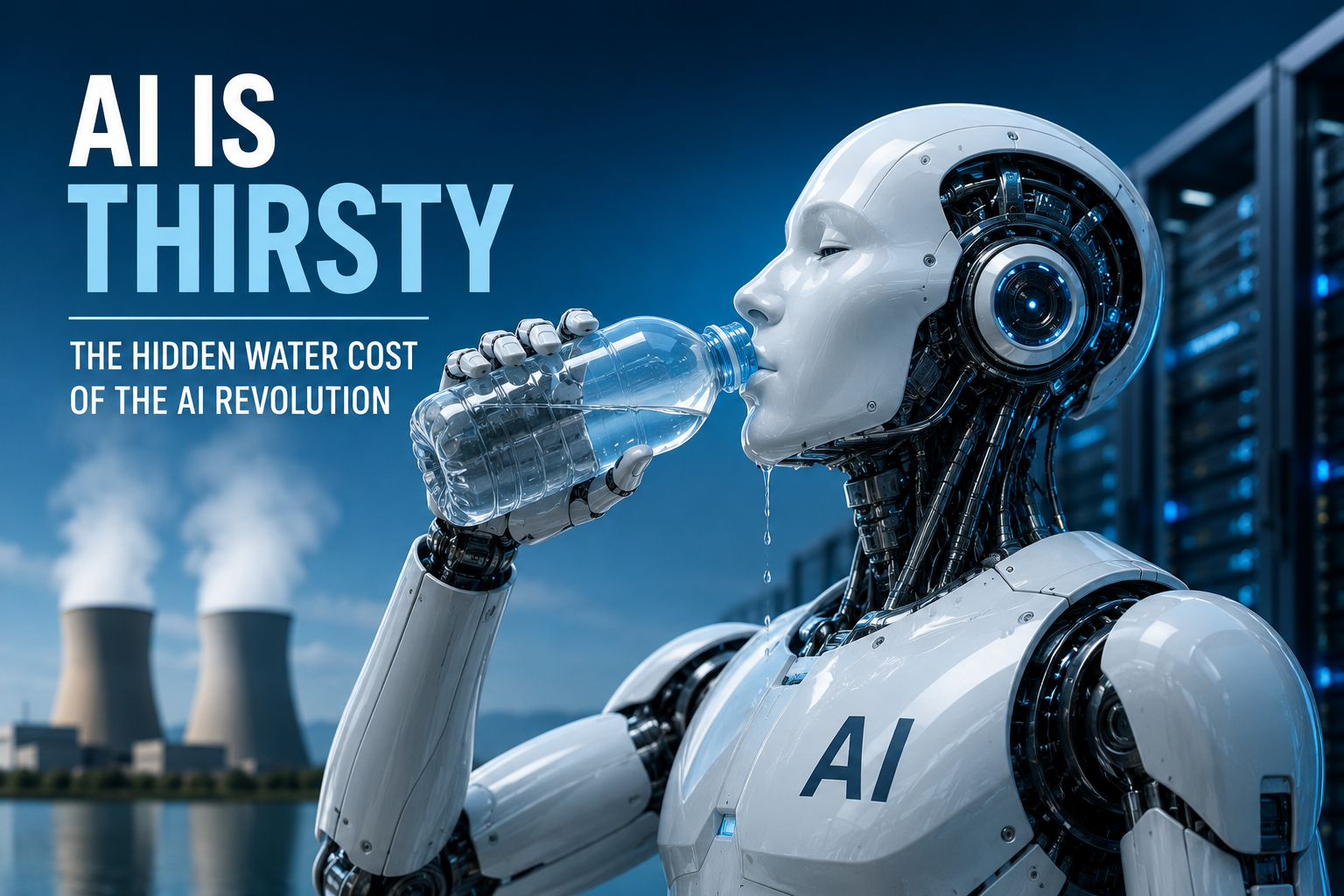
Artificial Intelligence is often portrayed as a clean, invisible technology. We interact with AI through screens, voice assistants, chatbots, image generators, and recommendation engines, giving the impression that intelligence now exists purely in the cloud. Yet behind every AI response lies a vast physical infrastructure consuming enormous amounts of electricity, computing power, and perhaps most surprisingly, water.
As the world races to embrace AI, a critical question is emerging:
Can we sustain the water demands of the intelligence revolution?
The Physical Reality Behind AI
When people think of AI, they imagine algorithms and software. In reality, AI runs on massive data centers filled with powerful computer servers operating around the clock.
These servers generate tremendous heat.
Whether training a large language model, processing millions of search queries, generating images, or running advanced analytics, the hardware powering AI consumes substantial amounts of energy. The hotter these systems become, the greater the need for cooling.
This is where water enters the picture.
Why AI Needs Water
Just like a car engine requires a cooling system, data centers require mechanisms to prevent overheating.
Many facilities use sophisticated cooling systems that rely on water to absorb and dissipate heat. Water may be used directly in cooling towers, indirectly through chilled water systems, or in evaporative cooling technologies designed to improve energy efficiency.
Every AI-generated response, image, video, or prediction contributes, however slightly, to the overall demand placed on these cooling systems.
The scale becomes significant when multiplied by billions of interactions each day.
In essence, AI doesn’t just consume electricity—it consumes water.
Training AI Models: The Biggest Water Consumer
The most water-intensive phase of AI development is training.
Training a large AI model involves processing vast datasets through thousands of specialized processors over weeks or even months. During this period, data centers operate at peak capacity, generating immense heat.
Researchers have estimated that training advanced AI systems can consume millions of liters of water, both directly through cooling and indirectly through electricity generation.
The larger the model, the larger the environmental footprint.
As companies compete to build ever more capable AI systems, the demand for cooling infrastructure continues to grow.
The Global Water Challenge
The timing of AI’s growth presents a challenge.
Many regions around the world are already facing increasing water stress due to:
- Climate change
- Population growth
- Urbanization
- Agricultural demand
- Industrial expansion
In water-scarce regions, the construction of large data centers can create tension between technological development and community resource needs.
The issue is not that AI should stop advancing. Rather, society must carefully consider where data centers are built, how they are cooled, and whether water resources are being managed responsibly.
The Sustainability Dilemma
Ironically, AI is often promoted as a tool to solve environmental problems.
AI can optimize energy grids, improve agricultural efficiency, reduce waste, forecast weather patterns, and accelerate scientific research. These benefits are real and potentially transformative.
However, every technological solution carries its own environmental cost.
The challenge is ensuring that the environmental gains produced by AI exceed the resources required to operate it.
Without transparency and accountability, the sustainability claims surrounding AI risk becoming incomplete.
Innovation Is Driving Solutions
The technology industry is not ignoring the problem.
Leading technology companies are investing heavily in:
Advanced Cooling Technologies
New cooling systems use significantly less water than traditional methods. Some facilities are moving toward closed-loop systems that recycle water rather than continuously consuming fresh supplies.
Liquid Cooling
Direct liquid cooling technologies can improve efficiency and reduce overall water requirements compared to conventional air-cooling approaches.
Renewable Energy Integration
By pairing data centers with renewable energy sources, companies can reduce the indirect water consumption associated with fossil-fuel power generation.
Strategic Location Selection
Many new data centers are being built in regions with cooler climates, where natural temperatures reduce cooling requirements.
The future of AI infrastructure will depend heavily on these innovations.
What This Means for Africa
Africa stands at an interesting crossroads.
The continent is expected to experience rapid growth in digital infrastructure, cloud computing, and AI adoption over the coming decades. At the same time, many African nations face recurring droughts, water shortages, and increasing climate pressures.
This presents both a challenge and an opportunity.
Rather than replicating older, resource-intensive models, African countries can design next-generation digital infrastructure that prioritizes sustainability from the outset.
Governments, investors, technology firms, and environmental stakeholders must collaborate to ensure that digital growth does not come at the expense of critical water resources.
The decisions made today will shape the continent’s technological future for decades.
The Future of Responsible AI
Artificial Intelligence is one of the most transformative technologies in human history. Its potential to improve productivity, healthcare, education, agriculture, and economic growth is immense.
Yet every technological revolution depends on physical resources.
The cloud is not floating in the sky. It is built on servers, power plants, fiber networks, and cooling systems that consume real-world resources.
Understanding AI’s water footprint is not an argument against innovation. It is an argument for smarter innovation.
The future belongs not merely to the most powerful AI systems, but to the most sustainable ones.
As AI continues to reshape our world, we must ask not only how intelligent our machines can become, but also how responsibly we choose to power them.
Because beneath every AI breakthrough lies a simple truth:
The future of intelligence may depend as much on water as it does on data.